


 In the days of my youth, we didn’t study women’s history as a unique subject. For that matter, I don’t remember that we spent much time at all on the suffrage movement or passage of the 19th Amendment. When the idea for Catching Katie came to me, I began researching suffragettes and what they went through to win the right to vote. I think of all of the research I have ever done, the research I did for Catching Katie impacted me the most. (The research proved handy for a later novel as well, A Vote of Confidence.)
The setting for Catching Katie was 1916 Idaho. My suffragette heroine became a candidate for the US House of Representatives. This was fiction, of course. An Idaho woman did not run for Congress in 1916. However, the truth wasn’t far off. A woman did run for the US House of Representatives in 1916, and she was elected to office. Her name was Jeannette Rankin, and she was from Montana. At the time of that election, the United States was still four years away from the ratification of the 19th Amendment, although many women in western states had been able to vote since the late 1800s.
Born in Missoula in 1880, Jeannette Rankin was the eldest daughter of a rancher and a schoolteacher. She graduated from Montana State University and attended the New York School of Philanthropy. It was while serving as a social worker in Spokane, Washington that she joined the woman suffrage movement. [Robin here: It is always “woman” suffrage, not “women” suffrage.] Her speaking and organizing efforts helped Montana women gain the vote in 1914.
 When Rankin decided in 1916 to run for congress, the novelty of a woman candidate helped her secure a GOP nomination for one of Montana’s two At-Large House seats. She ran as a progressive, pledging to work for a constitutional woman suffrage amendment and emphasizing social welfare issues. Rankin ran a nonpartisan campaign in a Democratic state during a period of national hostility toward parties in general. And this was the first opportunity for Montana women to vote in a federal election.
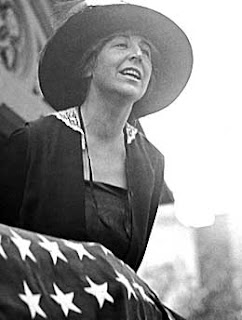 Rankin had just taken office when Congress met in Joint Session to hear President Woodrow Wilson ask to “make the world safe for democracy” by declaring war on Germany. The House debated the war resolution on April 5th, 1917. Given Rankin’s strong pacifist views, she was inclined against war and voted no when the time came. The final vote was 374 for the war resolution and 50 against.
As the first woman Member of the House, Rankin was on the frontlines of the national suffrage fight. During the fall of 1917 she advocated the creation of a Committee on Woman Suffrage, and when it was created she was appointed to it. In January 1918, Rankin opened the very first House Floor debate on a constitutional amendment on woman suffrage. “How shall we answer the challenge, gentlemen? How shall we explain to them the meaning of democracy if the same Congress that voted to make the world safe for democracy refuses to give this small measure of democracy to the women of our country?” The resolution narrowly passed the House amid the cheers of women in the galleries, but it died in the Senate.
Rankin served in the House for two years (1917-1919) but lost reelection. After that she divided her time on issues of pacifism and woman suffrage. She might never have run for office again if not for another looming world crisis. In 1940, she campaigned on an anti-war platform and won, taking office for the second time in 1941.
 Unfortunately, her vote against declaring war on Japan after the attack on Pearl Harbor (the vote was 388 to 1) rendered her second two-year term in office irrelevant. She lost the support of her constituents and was ignored in the House. She did not run for reelection, but she continued to campaign for peace and social reform for years to come, including demonstrating against the war in Vietnam. She died in May 1973.
It’s been 96 years since the first woman was elected to Congress. Today we don’t think it at all unusual to have women serving in any and all offices in government. We, the women of today, owe a lot to those intrepid women of yesteryear who fought for full rights of citizenship. Thanks, ladies.
(The primary source of information for this post was the History, Art, & Archives of the United States House of Representatives.)
